




















Freeman | Hindman June Sales Results
On June 6 in Chicago, Freeman’s | Hindman presented Fine Literature from the Collection of Richard C. McKenzie, which was met with tremendous enthusiasm from the market. Bidders vied for first editions and literary high spots of the 19th and 20th centuries with all 297 lots selling, of which nearly 60% sold for prices surpassing presale estimates. The collection drew international bidders, nearly 30% of whom were bidding with Freeman’s | Hindman for the very first time.
The collection included fine copies of high spots of American and English literature from the last two centuries with works by Jane Austen (1775-1817), Emily Dickinson (1830-1886), William Faulkner (1897-1962), F. Scott Fitzgerald (1896-1944), and Herman Melville (1819-1891) headlining the sale.
Highlights from the collection included: Emily Dickinson. Poems, Poems Second Series, and Poems Third Series. First editions, which
sold for $22,860; Herman Melville. Moby-Dick; or, The Whale. First American Edition, selling for $22,860; and F. Scott Fitzgerald. The Beautiful and Damned. First edition, first printing, which brought $16,510.
The top lot of the month came from the June 25 Books and Manuscripts auction in Philadelphia, where a rare portolan chart of the Mediterranean by Joan Oliva sold for $152,400, more than seven times the presale estimate. Oliva was the most prolific and highly regarded member of the distinguished Oliva family, a mapmaking dynasty that …more
The Morgan Library & Museum is pleased to present Crafting the Ballets Russes: The Robert Owen Lehman Collection, on view June 28 through September 22, 2024. The Robert Owen Lehman Collection, which has been on deposit at the Morgan for half a century, is the finest private collection of autograph manuscripts of Western music in the world. Among its many splendid works are deep holdings of early twentieth-century ballet materials, which will be shown together for the first time in this exhibition.
Crafting the Ballets Russes highlights the rise of women in leading creative roles in the creation of these seminal ballets, including the choreographer Bronislava Nijinska and the dancer/producer Ida Rubinstein. Organized around a series of ballets, the exhibition features sketches, drafts, and choreographic notations to show how composers, choreographers, and designers together created works of astonishing originality and lasting influence. On view are over 100 objects including rare music and dance manuscripts, photographs, and costume designs by artists Léon Bakst, Alexandre Benois, and Natalia Goncharova.
The exhibition opens with the dramatic arrival of Serge Diaghilev’s troupe of Russian dancers, the Ballets Russes, in Paris in 1909. Focused on Stravinsky’s prominent ballets Firebird (1910) and Petrouchka (1911), this section establishes the founding of the Ballets Russes with choreographer Michel Fokine, and Diaghilev’s discovery of Igor Stravinsky. With Stravinsky, the Ballets Russes brought music, choreography, and stage design together to the highest level for the first time, elevating the status of the composer. Music became the guiding art within the trinity of music, dance, and design.
The second section of the exhibition explores ballet modernism, primarily through Debussy’s The Afternoon of a Faun (1912) and Stravinsky’s Les Noces (1923). This section highlights the creative partnership between the dancers and choreographers Vaslav Nijinsky and his sister, Bronislava Nijinska. A significant series of Nijinska’s drafts and notes from the Library of Congress are on view, showing how she repurposed classical techniques and developed her own unique and impactful style.
The exhibition closes with Les Ballets de Madame Ida Rubinstein, the company founded in 1928 by Rubinstein, a producer and former star dancer of the Ballets Russes. Her company included other Ballets Russes alumni, among them Igor Stravinsky, Maurice Ravel, Alexandre Benois, and Bronislava Nijinska. Centered around Ravel’s iconic Boléro (1928) and La Valse (1920), the section highlights the significant contributions by women to which these pieces owe their lasting impact. Although Rubinstein produced important stage works and rivaled Diaghilev as a patron of new music, her legacy has been neglected. This section brings her contributions to light, along with the central roles that women, including Nijinska, played in her company.
Additional highlights from Crafting the Ballets Russes: The Robert Owen Lehman Collection include an early working manuscript of Firebird, created while Stravinsky was still relatively unknown. In the draft, one can see the edits that Stravinsky made to follow the choreographer Fokine’s ideas; later, Stravinsky’s music would take the lead. Also on view is an autograph manuscript of Boléro, showing the unfolding mechanical process that underlies the piece, inspired by the factory production lines of the time. “We are pleased to celebrate our centennial year with a presentation from the Robert Owen Lehman Collection, one of our most significant and cherished holdings at the Morgan,” said Colin B. Bailey, Director of the Morgan Library & Museum. “We are immensely grateful to have the collection on deposit, where it can be shared with scholars, students, and visitors alike. This exhibition, combining music manuscripts with loans relating to choreography and design, brings some of the most pioneering and enduring early twentieth-century classical music to life." For more information call: (212) 590-0311.
by John C. HuckansTogether We Thrive - Divided Not So Much
I think Voltaire was right. If people weren't able to lose themselves in their gardens or books, the world would surely go mad. Some days I think it already has. The last few years have not been happy ones for the republic for many reasons, not the least of which seems to be an officially-encouraged policy of divisiveness and inter-group hostility, carried out by a partnership of well-financed private advocacy groups and one of our major political parties. At the lowest level, failed or morally bankrupt politicians will beat the drums for war when the tide of public opinion turns against them and some folks, sadly, will support their elected leaders if they're told the nation is under military threat. In scenarios where a potentally fraught situation is caused or exacerbated by the leaders themselves, it might be called war in the national interest.
The “military/industrial complex” is much larger than it was in Eisenhower's time and I suspect there will never be a true accounting of the many hundreds of billions of dollars spent supplying arms to warring peoples in various parts of the world – most recently in Ukraine and Israel. Also, well-placed economic and political elites stand to make a lot of money in the nasty but lucrative side hustle of influence peddling, but when these actions and feckless policies lead to armed conflict, some of the bravest of the “elites” will express the willingness to fight, if necessary, to the last combatant – usually someone else's son or daughter and preferably from a working class background. …more
The Morgan Library & Museum is pleased to present Far and Away: Drawings from the Clement C. Moore Collection, on view June 28 through September 22, 2024, and Liberty to the Imagination: Drawings from the Eveillard Gift, on view June 7 through October 6, 2024. These two exhibitions, tied to promised gifts, celebrate the Morgan’s one hundredth year as a public institution.
Far and Away: Drawings from the Clement C. Moore Collection presents a selection of over eighty drawings from the promised gift of Clement C. (Chips) and Elizabeth Y. Moore; Liberty to the Imagination: Drawings from the Eveillard Gift, celebrates the promised gift of twenty-eight exemplary drawings from the collection of Elizabeth and Jean-Marie Eveillard. The works span from the sixteenth to the twentieth century.
Far and Away: Drawings from the Clement C. Moore Collection showcases a selection from one of the pre-eminent private collections of Dutch drawings in America. The exhibition is grouped thematically to highlight the principal themes of Dutch art, the various functions and techniques of Dutch Jan Siberechts (1627–1703), drawings, and the connections between the Dutch and other European artistic traditions. Works by Hendrick Goltzius, Jacob de Gheyn, Jan Brueghel, Peter Paul Rubens, Rembrandt, Peter Lely, Claude Lorrain, Thomas Gainsborough, and John Constable are among those featured.
The works in Liberty to the Imagination: Drawings from the Eveillard Gift exemplify the sense of wonder that underlies the Eveillards’ collecting practice. Describing it, Betty Eveillard has quoted the eighteenth-century French philosopher, Denis Diderot: “Perhaps we find sketches so attractive only because …more
by John C. HuckansThe Iron Cage, a Review
(originally published May 2014)
The literature of the Nakba (expulsion and dispossession of the Palestinian people, starting on or about May 15, 1948) is vast. There are many published personal narratives such as Sari Nusseibeh’s Once Upon a Country (NY, Farrar, Straus, 2007) and Karl Sabbagh’s Palestine, A Personal History (NY, Grove Press, 2007), unsparing historical accounts such as expatriate Israeli historian Ilan Pappé’s The Ethnic Cleansing of Palestine (Oxford, OneWorld, 2006), and countless books and essays focusing on various aspects of the struggle. There is even a significant sub-genre of literature relating to the “Israel Lobby” by such writers as ex-Congressman Paul Findley and more recently by academics John Mearsheimer (University of Chicago) and Stephen Walt (Harvard).
With this as a backdrop, it’s refreshing to read a book that places the Palestinian experience within a broader context. …more
The Morgan Library & Museum Presents: Walton Ford: Birds and Beasts of the Studio
The Morgan Library & Museum is pleased to present Walton Ford:Birds and Beasts of the Studio. Opening April 12 and on view through October 20, 2024, the exhibition celebrates the 2019 gift from artist Walton Ford (b. 1960) to the Morgan of sixty-three studies and sketches, shown publicly for the first time. Ford is fascinated by the perception of wild animals in the human imagination, and his monumental watercolors subvert historical conventions of animal painting. This exhibition examines the artist’s working process, illuminating the role that historical, literary, cultural, and scientific research plays in his practice. Presented together with drawings of animals and birds selected by the artist from the Morgan’s holdings, this exhibition sheds new light on the museum’s collection from the perspective of a living artist.
Birds and Beasts of the Studio opens with a selection of Ford’s drawings inspired by his visits to the American Museum of Natural History, New York. To this day, he visits the museum to explore its archives, field studies, documents, and taxidermy specimens. This section of the exhibition reveals the extensive scientific research that grounds Ford’s artistic practice, which relies on attention to detail and the accuracy of animal features.
The second section presents some of Ford’s studies and watercolors that imagine encounters between lions and humans, and are largely based on true stories. These works include a series centered on the Barbary lion — a now extinct subspecies which fought gladiators in ancient Rome and was used as the Metro-Goldwyn-Mayer (MGM) mascot. Also on view are compositional sketches from a series inspired by the escape of eight lions in Leipzig in 1913, as well as a work in which a lion devours famed Romantic painter Eugène Delacroix (1798–1863). Though humans hardly appear in …more
by John C. HuckansA Book Club of One
Note: The baying of the hounds from both sides of the aisle is a reminder that the quadrenniel political season is well under way, and what better excuse to reprint our review of Ray Ginger's biography of Eugene Debs, the labor reformer, socialist and ultimately crusading populist and pacifist who was convicted and sent to jail for his public speech.
*
The oldest book club I remember was the “Book-of-the-Month” club. My parents subscribed, which is how I first was introduced to Winston Churchill's 6 volume memoirs of World War II. Each volume, as published, may have been offered as a bonus to new members.
And while in boarding school in Connecticut, a faculty member promoted something called the “Book Find Club” where students interested in history, economics and philosophy could order new books from BFC catalogues at prices which seemed ridiculously low even at that time. Like a starving person at a Chinese buffet, I usually bought more than I could read before the next catalogue arrived.
One I remember reading almost immediately (biography refracted through the lenses of history, economics and philosophy) was Robert L. Heilbroner's The Worldly Philosophers. It was an expanded version of his PhD. dissertation and apparently was so successful that it was revised and reprinted several times. It is still widely offered on the internet by online sellers: “The Worldly Philosophers is a beautiful novel written by the famous author Robert L. Heilbroner. The book is perfect for those who wants to read philosophy, history books. The main character of the story are John Maynard Keynes, Adam Smith, David Ricardo, Thomas Robert Malthus, Thorstein Veblen” [sic]. Seriously, I kid you not.
At any rate, book clubs have proliferated over the years. Television personalities publicized eponymous ones, promoting books, often of the “as-told-to” genre, and almost immediately day time television watchers would order them on Amazon or head to the nearest Costco. There are also local book clubs that meet in libraries or in each others homes, where members take turns making selections. And at the height of the Pride & Prejudice craze some years ago, Book Source Magazine helped to publicize a “Jane Austen” book club – as I recall it ran out of steam after Northanger Abbey or Mansfield Park. With the demise of traditional bookstores, many of which stocked backlist titles on their shelves for years, of necessity the trend has been toward self-publishing or what used to be called “vanity press” publication. At its most embarrassing it can involve being invited to a gathering to hear an author speak about his or her book, while feeling the pressure to buy autographed copies at the conclusion of the talk. Rare unsigned copies of anything seem to be at a premium of late.
While some book clubs promote the idea of thousands of people reading the same book at the same time – I find myself more intrigued by the notion that sometimes I might be the only person on the planet reading whatever it is I'm reading at the time. Right now that book is …more
Beatrix Potter Exhibition at The Morgan Library
The Morgan Library & Museum is pleased to present Beatrix Potter: Drawn to Nature. Opening February 23 and on view through June 9, 2024, the exhibition tells the life story of Beatrix Potter, one of the twentieth century’s best-loved authors of children’s fiction. The exhibition is rooted in Potter’s relationship with the natural world, from the influence of the countryside in her youth to her passion for sheep farming and land conservation in adulthood.
Organized by the Victoria and Albert Museum (V&A), London, the exhibition brings 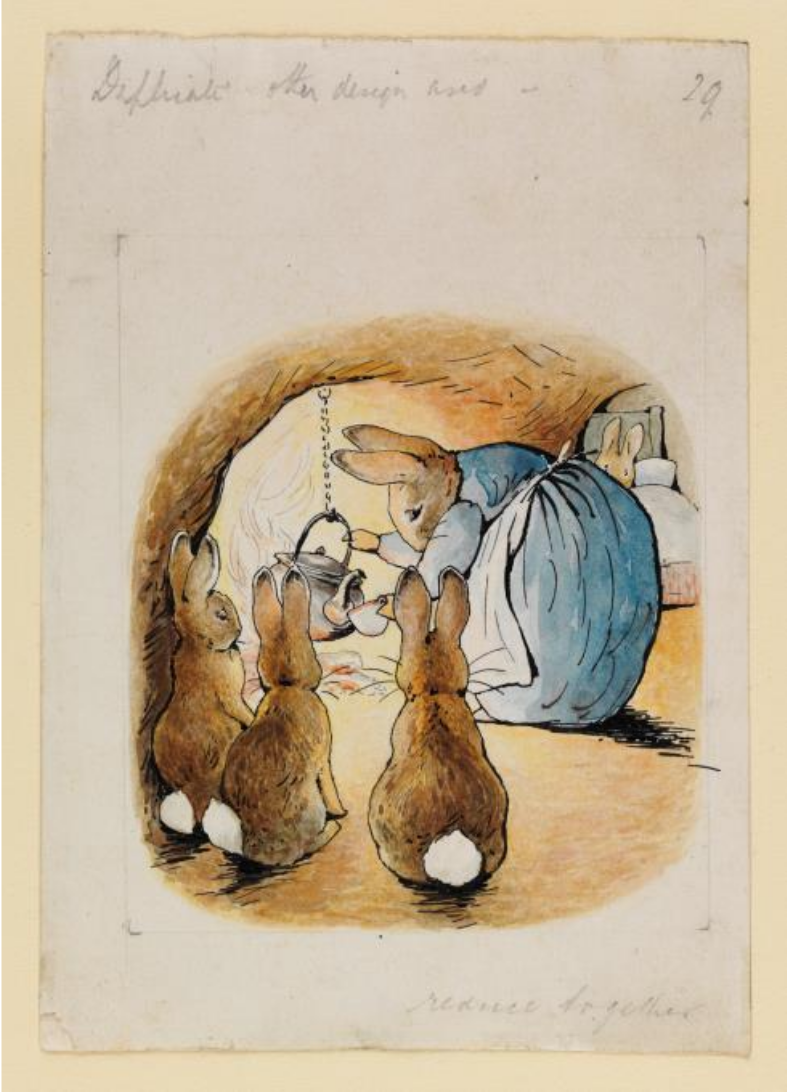 together artworks, books, manuscripts, and artifacts from several institutions in the United Kingdom, including the V&A, the National Trust, and the Armitt Museum and Library. Paired with the Morgan’s exceptional collection of Potter’s picture letters, these objects show how her innovative blend of scientific observation and imaginative storytelling shaped some of the world’s most popular children’s books.
The first section, Town and Country, establishes a sense of the places and spaces that defined Potter’s childhood, starting with her life in South Kensington, London. Exploring Potter’s family life and her development as an artist, this section includes early sketchbooks, objects from her home, artwork by her family, and even a page of an encrypted diary that Potter kept from her adolescence into her 30s.
The next section, Under the Microscope, examines Potter’s interest in the natural sciences, including insects, anatomy, and mycology, or the study of fungi. This section traces the fascination with animals that Potter shared with her brother, Bertram, highlighting their collection of pets, which the siblings studied by making drawings. It also showcases Potter’s work as an amateur mycologist through the display of intricate and scientifically impressive drawings of fungi.
The subsection “In the Country” delves into Potter’s formative childhood summers spent in Scotland and in northwest England’s Lake District, where she collected fossils, fungi, and other natural ephemera. It explores the influence of these travels with her family, emphasizing how nature shaped Potter’s artistic process, as seen in early sketches and picture letters depicting natural scenery.
The third section, A Natural Storyteller, reveals Potter’s almost accidental journey to becoming a best-selling author, centering on the beloved books that Potter wrote for children and the stories behind them. This section builds from her early commercial holiday card designs to her first book, The Tale of Peter Rabbit. On view are preparatory sketches for Peter Rabbit, as well as Potter’s paintings of the real-life places that inspired Mr. McGregor’s garden in The Tale of Benjamin Bunny. The installation 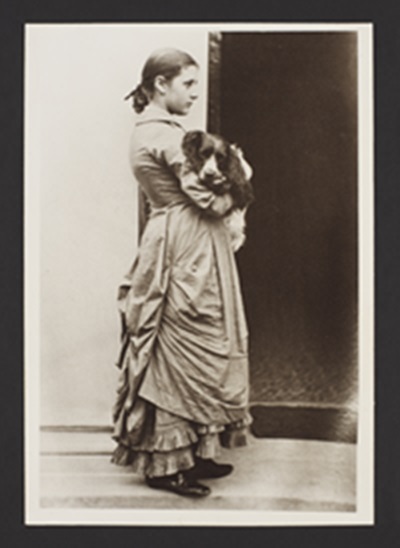 includes miniatures that reflect the small scale of many of Potter’s stories, including tiny letters that she wrote in the voices of her characters and sent to children.
Small-scale reading is central to an understanding of Potter’s work, and many of her “little books” that she published following The Tale of Peter Rabbit are also on view.
Finally, the section Living Nature follows Potter into her later life in the Lake District in northwest England. Through letters, photographs, and paintings, the section shows how Potter transitioned away from working as an illustrator and writer in order to dedicate herself to her community and its environment through farming and conservation. The show ends with a look at the four thousand acres she bequeathed to the UK’s National Trust, highlighting Potter’s extraordinary legacy, which persists not only in her books but in the environment itself: her efforts helped preserve the natural spaces that fostered her scientific pursuits and fired her imagination. Today, the National Trust owns and cares for over twenty percent of the Lake District, now a UNESCO World Heritage site.
Other highlights from the exhibition include an 1893 picture letter from Potter to a child named Noel Moore, in which she tells for the first time the story that would eventually become The Tale of Peter Rabbit. Also on view are personal effects from Potter’s life, from an early childhood paint box to a walking stick and clogs used in her later years in the Lake District.
This exhibition at the Morgan is organized by Philip Palmer, Robert H. Taylor Curator and Department Head of Literary and Historical Manuscripts, and was created by the Victoria and Albert Museum in London.
Beatrix Potter: Drawn to Nature will be on view at the Morgan Library and Museum, 225 Madison Avenue at 36th St., New York, NY, from February 23rd through June 9, 2024.
Hindman, to Merge with America's Oldest Auction House, Freeman’s
Today, the pioneering, full-service auction house Hindman announces that it will continue to expand its national footprint by merging with venerable, 200-year-old Philadelphia-based Freeman’s. With a combined six salerooms and 18 regional offices across the country, Freeman’s and Hindman stand to have the largest, coast-to-coast presence of any auction house in the United States, with plans to expand into international markets. The union of these two preeminent businesses represents the foundation of a dynamic and comprehensive company well- positioned to lead the upper-middle auction market. Under the name Freeman’s | Hindman, the company is combining their robust digital infrastructures into a singular website and highly targeted online initiatives.
As one of the first actions, Freeman’s | Hindman will be opening its new permanent New York saleroom in January 2024. Located at 32 East 67th Street in the heart of the Upper East Side’s art district with up to 5,000 square feet of space available to the company, it is truly setting its sights on New York as a major center of growth. For Freeman’s, it is a return to the city with a physical presence, although both companies have had senior specialists working with clients in New York for many years. This move is in response to the strong demand they have established in this vibrant and key area of the art market.
“I’m truly excited to bring together these two esteemed auction houses under one roof,” asserts Executive Chairman, Jay Frederick Krehbiel. “The merger strengthens our advantage in an increasingly competitive auction market and sets us up for continued growth across the United States and globally, especially with Freeman’s existing international relationship with Lyon & Turnbull.”
Driven by a client-first approach, dedication to excellence, and innovative strategy, the two houses are natural partners. As America’s oldest auction house, Freeman’s adds more than two centuries of achieving market-setting results to Hindman’s 40-year record of realizing stellar prices while providing outstanding service, particularly to trusts and estates professionals nationwide. A strength also lies in both firms’ specialist teams, whose profound knowledge and unrivaled expertise span all …more
Outstanding Results at Potter & Potter Auctions Magicana Sale
Potter & Potter Auctions' December 9th sale had a 99.3% sell through rate, with prices noted including the company's 20% buyer's premium.
The top lot in this sale was Harry Houdini's (Erik Weisz) Death-Defying Mystery. Estimated at $40,000 - 60,000, it brought $180,000 - three times the high estimate. The linen backed rarity, one of perhaps five extant, measured 40" x 30” 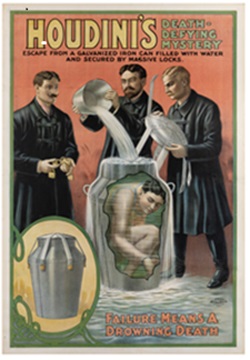 and was published in Cincinnati & New York by Russell-Morgan Litho. in 1908. The one sheet color lithograph depicted Houdini in his Milk Can escape, crouched down inside the metal container with water pouring down over his body. The poster, acquired at the Houdini Estate Sale held in New Jersey in 1981 by a former owner, was removed from one of many trunks found in the basement of Houdini’s home at 278 West 113th Street in Harlem, where it had been stored in the decades following the magician’s death.
Thurston (Kellar’s Successor) - Invested with the Mantle of Magic, was estimated at $15,000-25,000 and realized $48,000. The half-sheet lithograph promoting magician Howard Thurston was published in Cincinnati by The Strobridge Litho. Co. in 1908. Measuring 30" x 20” and depicting Thurston and fellow magician Harry Kellar side-by-side, with Mephistopheles looking on at the historic scene on the stage of Ford’s Theatre in Baltimore, when Thurston was presented with Kellar’s “mantle” of magic.
A collection of Suzy Wandas' (Jeanne Van Dyk) performing apparatus, estimated at $5,000-8,000, sold for $38,400. The case held virtually all of the props used by Wandas for the act she presented in variety theaters around the world. These include pails, holders, metal stands, a vanishing cane and an appearing cane; palming coins; multiplying billiard balls, her make-up bag and makeup; silks and flags; dummy cigarettes and gimmicked matchboxes; a breakaway fan; playing cards; and many others. According to Potter's experts, this was "a remarkable time capsule of one of the few female performers to excel as a variety artist in the twentieth century as a magician – not to mention as part of a family act, on circus, and as a musician, on two sides of the Atlantic."
Jean Eugène Robert-Houdin's Quadrille Mignonette des Soirées Fantastiques de Robert-Houdin, estimated at $1,000-2,000, fetched $28,800. This book of …more
Results of Hindman's Recent Fine Books & Manuscripts Auctions
A complete copy of Edward S. Curtis’s seminal The North American Indian, arguably the most complete ethnographic record of the native peoples of North America ever assembled, stole the show in two days of Fine Books & Manuscript auctions at Hindman on November 9 and 10. The Curtis was the top lot of the single-owner Fine Books from the Dorros Family Collection auction on November 9, which saw a sales total of $1.5 million. Combined with the various-owner Fine Printed Books & Manuscripts, including Americana auction on the following day, the Chicago auction house achieved $2.4 million during the back-to-back sales.
Documenting one of the great races of mankind Curtis’s The North American Indian was one of the most ambitious and expensive publication projects of its kind, taking more than two decades to complete and resulting in one of the most important published works of the 20th century. All told, The North American Indian comprises 40 volumes: 20 text volumes featuring 1,511 illustrations, 1,505 photogravures, four maps and two diagrams, along with 20 supplemental folio volumes featuring some 723 full sheet photogravures in sepia, many of which have become iconic images. Funded in part by JP Morgan, Curtis set out to document as much of Native American culture and history as he could. Writing in the introduction, he explained that “the mode of life of one of the great races of mankind, must be collected at once or the opportunity will be lost.” Complete sets in any condition are rare on the market and therefore highly coveted, and the set offered from the Dorros Family Collection auction attracted enthusiastic bidding that sent the piece past its low estimate selling for $882,000 to …more
Ricky Jay Collection Part II Fetches Nearly $518,000
Potter & Potter's remarkable event, featuring ephemera, correspondence and artifacts from the collection of the late actor, sleight-of-hand magician and noted author Ricky Jay, realized $518,000.
The 323 lot auction held on October 28, 2023 had a sell-through rate of 98% with an average lot value of $1,600. All prices noted include the auction house's 20% buyer's premium
The top lot in this sale was an archive of correspondence between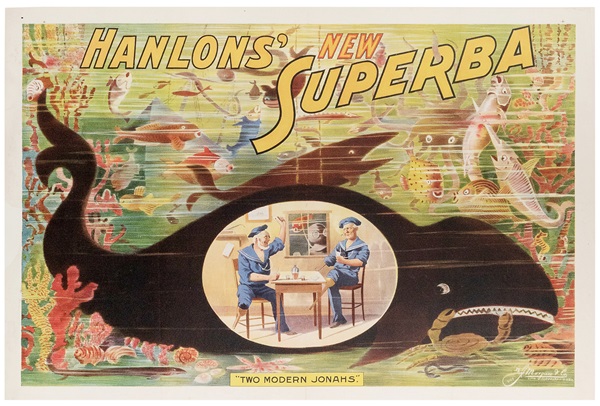 Karl Germain (b. Charles Mattmueller, 1878–1959) and his assistant, student, successor, and friend, Paul Fleming. This collection of written materials from 1908 to 1959, estimated at $30,000-60,000, brought $66,000. A highlight of this grouping was a note from Germain explaining the construction, packing, and details of his one-man Spirit Cabinet, a routine he developed after his Chautauqua and Lyceum heyday, the secret of which was not revealed in the books authored by Stuart Cramer that chronicle Germain’s life and magic.
Three scrapbooks and other materials chronicling London's Bartholomew Fair and its popular entertainment, estimated at $8,000-12,000, realized $27,600. They were compiled in the 19th century and included more than 400 pages of notes, broadsides, engraved portraits, book extracts, news clippings, letters, and related memorabilia chronicling the August celebration held annually from 1833 -1855.
Three Shows In One. The World Famous Houdini, Master Mystifier, was estimated at $5,000-10,000 and fetched $14,400. The oversized white, black, and orange linen backed broadside was printed in 1925 and was decorated with Houdini’s bust portrait, bats, and a witch. It was made to promote Houdini’s final tour, which ended unexpectedly with his hospitalization after sustaining a blow to the …more
Potter & Potter's Antarctic Expedition Sale Realizes $630,000
Potter & Potter Auctions has announced the results of the 430 lot sale held on October 12, 2023. The auction had an average lot value of nearly $1,500 and prices noted include the auction house's 20% buyer's premium.
The top lot in this sale, the original 35mm motion picture camera used to film parts of Richard E. Byrds' first Antarctic expedition, estimated at $30,000-50,000, made $40,000. The footage produced from the camera would go on to be used for the film “With Byrd at the South Pole,” issued in 1930.
The camera was used between 1928-30 by Paramount Publix Corporation cinematographers Willard Van der Veer and Joseph T. Rucker, the first professional cinematographers in Antarctica who also won the Academy Award for Best Cinematography, the first documentary to win an Oscar.
Other outstanding lots in the sale included Ernest H. Shackleton's The Heart of the Antarctic, Being the Story of the British Antarctic Expedition of 1907-1909 and The Antarctic Book. Winter Quarters 1907-1909, estimated at $20,000-30,000 and which sold for …more
Doings at the Morgan: Early Modern Illustrated Herbals, Opening October 6
Seeds of Knowledge highlights the collection of 15th to 17th-century European printed herbals of Dr. Peter Goop (Liechtenstein). Herbals were highly illustrated, critical texts to doctors and lay healthcare providers that included both the folkloric and medicinal uses of plants. The text and illustrations were repeatedly refined as the medicinal benefits of a plant’s use were more clearly understood and the style of illustration tended towards higher degrees of naturalism. These books were working manuals and frequently annotated by readers with notes of herbal recipes/medicines or other uses not found in the printed text. Dr. Goop’s collection is one of the most extensive in private hands. Using the Morgan’s 10th-century manuscript of Dioscurides’ De materia medica (MS M.652) as a centerpiece, this Thaw Gallery exhibition will explore developments in the understanding of the healthful and healing properties of plants, as Europe moved away from medicinal folklore towards an increased understanding of the natural world.
For more information contact Noreen Khalid Ahmad at (917) 805-4128 or nkahmad@themorgan.org.
A Season of Book Auctions at Swann
Books and manuscripts had a standout winter/spring season at Swann Galleries. “As a company whose origins are as a book auction house, it is reaffirming to see this growth, over 25%, in our book department over the last year. Even more exciting is that the results reflect not only strength in our established departments but also great momentum in our latest 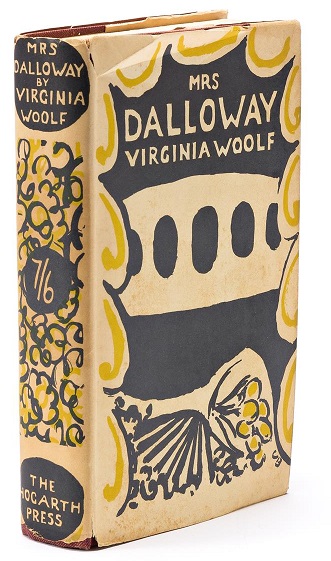 specialized sale, Focus on Women,” noted President Nicholas D. Lowry.
The top auctions of the season included two record-breakers in their respective categories: Printed & Manuscript African Americana and Early Printed Books. Both sales recorded their highest totals in history at the house. African Americana earned $1,378,838 on March 30, and the timed online auction of Early Printed Books closed on May 4 at $1,326,560.
Highlighted sales included an inscribed carte-de-visite portrait of early photographer James Presley Ball, circa 1870, at $125,000—Ball was one of the first Black photographers in America, learning his trade in Boston, launching his own itinerant studio in 1845, settling in Cincinnati from 1849 through the early 1870s, and then running studios in a succession of several southern and western towns until his death in Hawaii in 1904. Also of note was a 1949 edition of The Negro Motorist Green Book, which earned an auction record for any Green Book at $50,000.
Works by William Shakespeare drew strong interest from collectors in the May 4 auction. King Lear; Othello; and Anthony & Cleopatra, extracted from the first folio, London, 1623, sold for $185,000; a first edition of D’Avenant’s adaptation of The Tragedy of Hamlet, Prince of Denmark, London, 1676, earned $42,500; and a first edition of The Two Noble Kinsmen: Presented at the Blackfriers by the Kings Maiesties servants, with great applause, London, 1634, brought $81,250.
Senior Specialist, Devon Eastland commented: “Speculation on the strength of collecting markets for art and antiques is rampant, but Swann's most recent Early Printed Books sales, teeming with English literary highlights and rarities mainly from the Elizabethan era, remained very strong. The interest of hardcore collectors of fine books from the handpress period is abundantly evident, especially when the offerings include important books in excellent condition and almost unobtainable editions of titles world-renowned to obscure.”
Additional season highlights included a first edition of Virginia Woolf’s Mrs. Dalloway, London, 1925, in the rare dust jacket entirely unrestored ($30,000); a first American edition in the first state binding of Herman Melville’s Moby-Dick; or the Whale, New York, 1851 ($27,500); and …more
Potter & Potter's Fine Books & Manuscripts Sale Realizes $628,000
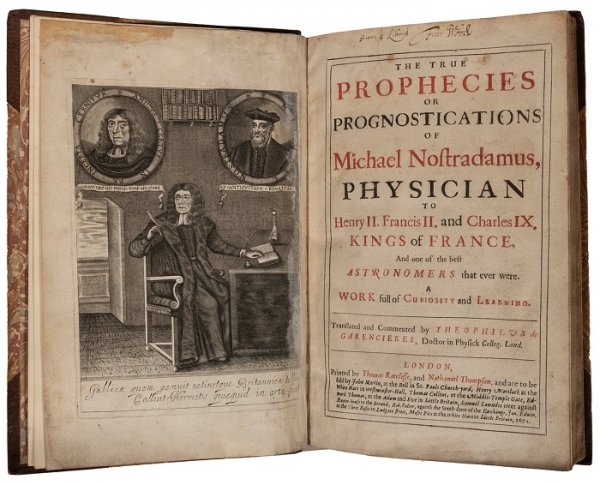 Potter & Potter Auctions announced the results of their early summer Fine Books & Manuscripts sale held on June 1st, 2023. It featured 510 lots, had a 97% sell through rate and all prices noted include the company's 20% buyer's premium.
Of the fine selection of groundbreaking first editions, Charles Dickens' Great Expectations, was estimated at $8,000-12,000 and sold for $24,000. The first edition, first issue copy was printed in London by [C. Whiting for] Chapman and Hall in 1861, and was among the earliest printings of its type, given its well documented errors and layout.
Howard Phillips Lovecraft's The Outsider and Others, was estimated at $4,000-6,000 and made $11,400. This first edition of the first book published at Arkham House in 1939 retained its rare and original dust jacket, and was one of only 1,268 copies printed by the publisher of weird fiction and horror.
William Edward Burghardt Du Bois' (1868-1963) The Souls of Black Folk, estimated at $3,000-5,000, realized $14,400. This first edition was published in Chicago by A.C. McClurg & Co., in 1903 and was a very fine example of Du Bois’s most famous work, which remains a landmark in the history of sociology and a cornerstone of African American literature to this day.
Henry Roth's Call It Sleep, was estimated at $3,000-5,000 and fetched $9,000. This copy of the first edition of the author’s first book was published in New York by Robert O. Ballou in 1934, included its rare first issue dust jacket, and was from the personal library of Larry McMurtry.
Thomas Hardy's The Trumpet-Major. A Tale, was estimated at $2,000-3,000 and brought $11,400. This first edition in book form was printed in London by Smith, Elder & Co. in 1880. This example in its rare secondary binding was originally published as a serial in Good Words magazine that same year.
Heinrich Klüver's Mescal: The ‘Divine’ Plant and its Psychological Effects, was estimated at $250-350 and sold for $2,880. Published in London by Kegan Paul, Trench, Trubner & Co. in 1928, this first edition was inscribed by Klüver and was the first work in English to study the psychoactive compounds of mescal. The lot also included a group materials related to Klüver including a booklet inscribed by Dr. Ronald Siegel.
Alice B. Toklas' The Alice B. Toklas Cook Book, was estimated at $1,000-2,000 and sold for $12,000. Published in New York by Harper & Brothers in 1954, This first American edition included her hand-written inscription of her famous “haschisch fudge” recipe. The lot included …more
by John C. HuckansOn Political Realignment (or Fear and Loathing inside the Beltway)
(originally published March 17, 2017)
The U.S. Election of 2016 was a game-changer for all sorts of reasons. To say the populist revolt came as a surprise to party regulars across the political spectrum is an obvious understatement, but the resulting emotional meltdown by people still in shock over the shifting loyalty and unexpected response of traditional working class voters (many of whom had supported Democrats since the Great Depression of the 1930s), only shows that it pays to do your homework. People who follow this column will recall that in July of 2016 we explained some of the reasons why Trump would perform bigly¹ in the 2016 general election. What follows is some observation and analysis that may contribute towards an understanding of recent trends. Or maybe not.
Party labels are just that – labels and nothing more. People who make a living seeking and trying to hold on to public office sometimes learn, to their annoyance, that …more
PBA's Sci/Fi, Fantasy, Horror Auction totals $500,000
PBA Galleries (PBA), one of the largest and most successful specialty auction houses in the world, completed an auction of over 400 lots of fine science fiction, fantasy and horror on June 2nd. . The sale featured signed and inscribed copies of major works by Stephen King, Philip K. Dick, Isaac Asimov, Octavia Butler, Frank Herbert, Ray Bradbury, Robert Heinlein, and many others.
The auction consisted of mostly signed first editions in exceptional condition. The wonderful examples in original dust jackets were from a single collection with many books rarely seen signed. Several new auction records were achieved during the sale, and when the hammer fell on the final lot, bidding had exceeded the highest estimate.
Samples of high performers include Dune by Herbert Frank ($22,500), The Dark Tower series by Stephen King ($22,500), The Lathe of Heaven by Ursula K. Le Guin ($10,000), Stranger in a Strange Land by Robert A. Heinlein ($11,250), The Foundation Trilogy by Isaac Asimov ($15,000), and Do Androids Dream of Electric Sheep? by Philip K. Dick …more
Results of Hindman's May 11th Books & Manuscripts Sale
First editions of each of Jane Austen’s major novels led Hindman’s May 11th Fine Printed Books & Manuscripts auction. The five books, including Austen’s Pride and Prejudice and Sense and Sensibility, realized more than $300,000. Overall, the sale brought more than $1.1 million, with a 94 percent sell-through rate.
“The passion of private collectors for rare works of literature and first editions led to very competitive bidding on the Jane Austen novels,” commented Gretchen Hause, Hindman Vice President of Books & Manuscripts. “We are thrilled with the results, and to see that the market for literature, and particularly for literature written by women, continues to gain strength.”
Highlighting the five Jane Austen first editions was Pride & Prejudice, which sold for $107,100, more than double its high estimate. The work, written by Austen at the age of 21 and finally published 15 years later in a small edition of approximately 1500 copies, stands as one of the most enduring and beloved works of 19th century literature. Austen’s first novel Sense and Sensibility sold for …more
Some Results of Freeman's May 3rd Books & Manuscripts Sale
Freeman’s May 3 Books and Manuscripts auction was marked by fierce bidding competition over presidential material and significant Americana, resulting in the remarkable $441,000 sale of a volume from the personal library of George Washington.
“The market for presidential books, documents, and autographs is quite strong, and this exceptional result really drives that home,” says 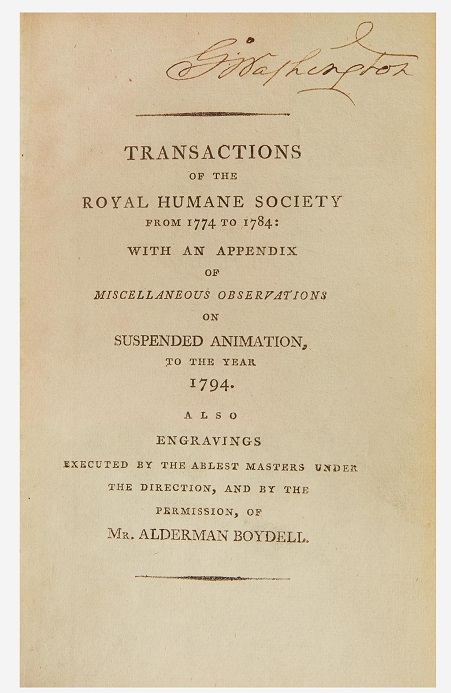 Darren Winston, Head of Freeman’s Books and Manuscripts department. “As rare as material like this is, it’s still Freeman’s bread and butter, right in our wheelhouse, and we’re thrilled with the result—as is the consignor.”
The first edition of The Transactions of the Royal Humane Society was given to Washington during his second presidential term by physician Dr. John Coakley Lettsom, and features Washington’s bold signature at the top of the half-title page.
As books from Washington’s library seldom come to auction, this volume represented a very rare market appearance, with corresponding results: the title exceeded its pre-sale high estimate of $18,000 by more than 24 times following a spirited bidding war. Several other lots outperformed their estimates in Wednesday’s auction, including a fresh-to-market manuscript receipt for the delivery of John Dunlap’s just-printed Declaration of Independence, dated July 10, 1776, signed and inscribed by Owen Biddle (achieved $32,760; estimate: $3,000-5,000); an autograph letter signed by Thomas Jefferson (sold for $27,720; estimate: $15,000-25,000); and a 1787 land grant signed by Benjamin Franklin (achieved $17,640; estimate: $10,000-15,000).
A 1593 first edition of George Gifford’s A Dialogue Concerning Witches and Witchcraftes also outperformed estimates, achieving $17,640 (estimate: $3,000-5,000). Sixty-seven of the sale’s lots were from the Children’s and Illustrated Books Library of Nicholas Wedge, and together brought $105,556 against a pre-sale low estimate of $54,500.
Freeman’s next Books and Manuscripts auction, A Fine Collection of American Literature and History, will be held June 8. Freeman’s invites consignments of books and manuscripts year-round. For more information about consigning with Freeman’s, please contact Darren Winston (dwinston@freemansauction.com or 267.414.1247).
Swann's African Americana Sale
Swann Galleries’ annual Printed & Manuscript African Americana auction on March 30 was by a wide margin the most successful in its 28-year history. The sale set records with $1,377,463 in total sales and an even 94% sell-through rate. Eight lots hit the $50,000 mark—after only 14 lots having hit that mark in the previous 27 years combined. 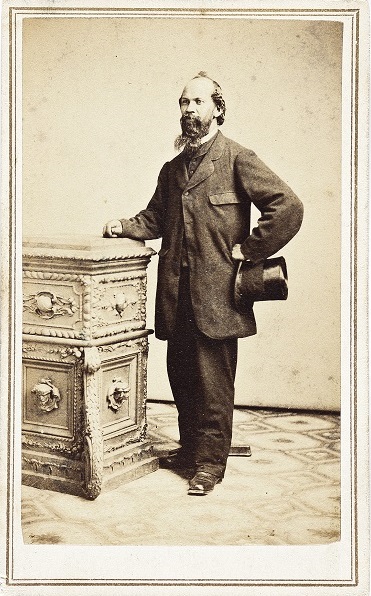 It was the third-largest sale in the long history of the house’s book department, behind only two noted single-owner sales, the Epstein sale of 1992, and the Ford sale of 2012. All prices included the Buyer’s Premium
The most notable feature of the auction was very strong bidding from institutional buyers. 43 different institutions were registered to bid in the auction. At least 105 lots were sold to 29 different institutions, in addition to numerous lots bought for institutions through private agents. “Numerous libraries, archives, and museums across the country are making up for lost time by increasing their representation of black history. For 25 years, Swann has been the leading conduit for bringing this source material from private hands into public hands,” noted Rick Stattler, director of books and manuscripts and specialist for the sale.
The top lot in the sale was an inscribed carte-de-visite by the important early photographer James Presley Ball, which brought $125,000. Only one other photograph of Ball is known to exist. A signed 1862 essay by the white abolitionist Portia Gage brought $8,000; it had been acquired from another auction house in 2003 for $345.
Items relating to slavery and abolition included an archive of letters from Richmond slave dealers, found an institutional home at $50,000, and the papers of abolitionist Theodore Bourne which included the minutes of the African Civilization Society reached …more
Outsider Artists Lead Hindman's Auction of Susan Craig Collection
Works by Roger Brown, Sister Gertrude Morgan, and William Dawson led Hindman’s single-owner auction of collector Susann Craig’s estate on March 9. A beloved figure in Chicago’s art world and a founder of Intuit: The Center for Intuitive and Outsider Art in Chicago, Craig left a strong legacy through her collection and passion for amplifying overlooked voices. The majority of works exceeded their estimates, with Chicago artists in particular seeing high-demand across the 325-lot sale.
Overall, the auction realized more than $551,000, well above the total estimate. A portion of the proceeds will benefit Intuit. “It was an absolute privilege to honor a woman who was so admired in Chicago,” commented Zack Wirsum, Director & Senior Specialist of Post-War & Contemporary Art. “Susann lived an incredibly rich life, and the success of the auction reflects her role as both a collector and a connector.”
Brown’s Crossing the Bandiagara Escarpment With Baobab Trees and Dogon Dancers, a very personal painting for Susann Craig, was the top lot of the auction, fetching $138,600 against a $60,000-80,000 estimate. 1989 was a pivotal year in the Chicago Imagist’s career, featuring his artistic responses to a range of subjects and issues.
The work was inspired by Brown’s 1988 trip to …more
Potter & Potter Auctions' Fine Books & Manuscripts Sale Exceeds $630,000
Potter & Potter Auctions' first book sale of 2023 (Thursday, February 16th) realized over $630,000 with a sell through rate of 95%. Prices noted below include the company's buyer's premium.
Books by, or with ties to Samuel L. Clemens ("Mark Twain", 1835–1910) performed well. A first edition, presentation copy of W.W. Jacobs' (British, 1863-1943) Salthaven inscribed to and by Twain, was the top lot in the sale. It was estimated at $25,000-35,000 and fetched $31,250. It was published by Methuen & Co. in London in 1908. In addition, Twain inscribed on the half title “It’s a delightful book. Mark." Below, Twain further reaffirms this statement, apparently in passing the book to someone else: “Bog House, Bermuda, March/10. I have read it about 5 times. The above verdict stands."
A 37 volume collection of The Works of Mark Twain published in New York by Gabriel Wells between 192 and 1925, was estimated at $6,000-8,000 and made $11,875. The limited edition set, number 79 of 1024 copies of the “Definitive Edition”, was signed by Twain on the front flyleaf of volume I. All volumes retained their original dust jackets. A 25 volume collection of Mark Twain's Works published in Hartford by the American Publishing Company between 1899–1907, was estimated at $8,000-12,000 and achieved $16,250. This set, number 233 of 512 copies of the “Autograph Edition” for subscribers - was published on india paper designed by Tiffany & Co. and etched by W.H.W. Bicknell. It also featured numerous engravings, 18 of which were signed by their respective artist. This collection is considered the rarest and most desirable of all the Twain sets according to experts. A first edition of Mark Twain and Charles Dudley Warner's The Gilded Age: A Tale of Today, was estimated at $6,000-8,000 and fetched $16,250. It was printed in Hartford and Chicago by the American Publishing Company; F.G. Gilman & Co., in 1873. Also, two manuscript pages by Twain and Dudley were inserted in the copy. The first was in Twain’s hand and numbered 166 at the top; the other leaf was in Dudley’s hand and numbered 1446 at the top.
This sale featured remarkable first editions of some of the noteworthy books of the past two centuries. J.R.R. Tolkien's The Lord Of The Rings trilogy, 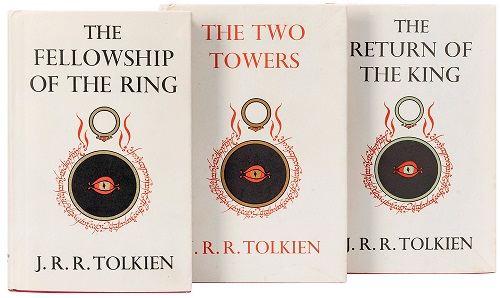 estimated at $10,000-15,000, sold for $19,200. This trilogy included The Fellowship Of The Ring (1954), The Two Towers (1954) and The Return Of The King (1955). All were published in London by Allen & Unwin Ltd. and the provenance included the bookseller, R.S. Heath Ltd.
Richard Nixon's (1913–1994) Real Peace: Strategy for the West, was estimated at $250-350 and realized $2,375. Privately printed in New York in 1983 this advance copy and galley proof was a first edition and one of 1000 copies of the private edition printed before publication. It included a TLS from Nixon to Martin Hayden which stated, “In view of the current national debate on foreign policy issues, I thought you might like to have a copy of the page proofs of a book on Soviet–American relations which I have just completed… I am publishing and distributing the book privately…to a selected number of government officials and opinion leaders in the United States and abroad who have expressed a serious interest in …more
by Donna HowardVermont Spring Book & Paper Fair Changes Hands
Over the years the Vermont Antiquarian Booksellers Association’s Spring Book & Paper Fair has been through a number of changes. Under the management of Greg Glade of Top of the World Books, it started in a hotel in South Burlington in 1993. After a few years I started managing the fair for the VABA, 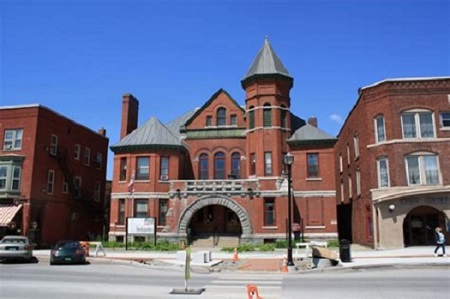 eventually moving it to a hotel in downtown Burlington. Over the years dealer and public attendance fluctuated with the vicissitudes of the antiquarian market, booming during the early days of the internet and then shrinking as many dealers started selling exclusively online.
Sadly, the pandemic forced a cancellation of the 2020 spring book fair only a week before it was to take place, but by the winter of 2021 (after the spring 2021 fair had also been cancelled) people were a little more comfortable meeting face-to-face and VABA decided to bring it back in 2022. However, the uncertainties of changing city regulations and the increasing costs in Burlington prompted another move - this time to downtown St. Albans. While a little more distant from the major population center of Burlington, the beautiful, historic auditorium in St. Albans City Hall with its wonderful natural lighting more than made up for it. Loyal bibliophiles followed the fair to the new location and the dealers who participated had a wonderful time despite the smaller crowds.
The move was controversial within the association, however. At the winter meeting, there was a lengthy discussion about …more
by John C. HuckansEnd of the Road for a College
The village in which I live (Cazenovia in central New York) has a college, which traces its roots to 1824, that is about to close at end of the current semester. For most of its life it was a secondary school or seminary run by the Methodist Church. At some point it cut its religious ties and became a two-year college for young women. The first time it closed was in May of 1974 - I remember it well because we heard the news on the radio as we were driving down I-81, having just returned from a year in Spain (Granada) by way of the Stefan Batory, sailing from London to Montreal.
The college was rescued thanks mainly to the support of local friends and business people. Also, long-term debt was not a major factor at that time. The new administration made some major changes - admitting young men and then expanding to a four-year program, while taking on a lot of long-term debt to fund ambitious building projects. Even though Pell grants brought in a lot of money that colleges were allowed to keep even when academically-unqualified students dropped out part way through Freshman year, this did not help build a deep or loyal alumni base. Also, with almost free tuition at NYS public colleges available to NYS residents, enrollment at many expensive private colleges has declined throughout the region.
N.B. The college (I did my undergraduate & graduate work elsewhere) that our family has contributed to significantly for some years (I've never even set foot on its campus) has been in existence since the 1840s and is in financially sound condition. It has a supportive alumni base, accepts no Pell Grant funding or any other form of government support (with accompanying constraints) and as a result remains one of the few oases of intellectual and academic freedom in the United States.
A noteworthy collection of letters by notorious American gangster Al Capone achieved exceptional prices in Hindman’s November 8th-9th Fine Books & Manuscripts auction. Books and manuscripts authored and signed by presidents and world leaders from the Patrick Atkinson Collection also attracted significant attention, with new auction records set for books signed by Martin Luther King, Jr. and Gandhi. The total sale nearly doubled its estimate, and realized over $1.2 million, representing one of Hindman’s most successful various owner Books & Manuscripts auctions in recent years.
A group of three Al Capone letters saw incredibly competitive bidding, with two of the letters selling in the top five lots of the auction.
Highlighting the group was a letter written by Capone two days after the January 1925 assassination attempt on his life, which soared past its $10,000-15,000 estimate to fetch $53,125. Another manuscript letter from Capone, written from Cicero in 1924, more than tripled its presale estimate to sell for …more
Washington Letter to Jefferson Exceeds Estimate
Freeman’s November 15 Books and Manuscripts: Rare Americana auction featured the $2,389,500 sale (est. $1 - 1.5 million) of the letter George Washington sent to Thomas Jefferson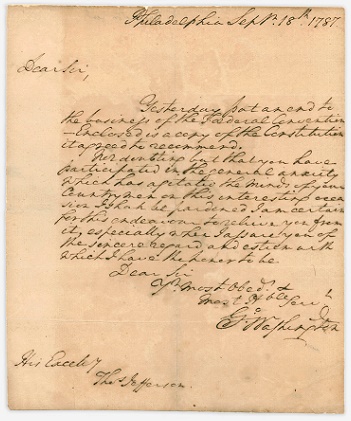 announcing the Constitution’s completion, one day following its adoption by the Constitutional Convention.
“We’re thrilled by the sale of Washington’s letter to Jefferson, and so is the consignor,” says Darren Winston, Head of Freeman’s Books and Manuscripts department. “It’s always really exciting to bring rare documents like this to market, but especially—as in this case—when the letter is so deeply connected to the founding of the nation.”
At the time of the Constitution’s signing, Jefferson, who authored the Declaration of Independence, was representing America in France. The Constitutional Convention was sworn to secrecy in the summer of 1787, but Washington was eager to pass the news along to Jefferson as soon as the landmark document was signed.
In this way, the letter not only reflects the high regard in which Washington held Jefferson, it also provides a critical link between two of the nation’s founders and offers a window into a world where breaking news could take weeks or months to arrive.
The remarkable sale, held in the midst of American election season, confirms Freeman’s pride of place in bringing foundational early American letters and documents to market. The $2.4M sale of this rare letter on Tuesday is one of a series of Freeman’s recent successes presenting such material at auction, including the $1.8M sale of a 1776 letter announcing America’s independence, to the state of Georgia, signed by John Hancock and the …more
Old Editions (954 Oliver St in North Tonawanda, NY (near Niagara Falls) is one of the country’s largest antiquarian bookstores—with 35,000 square feet of retail, gallery 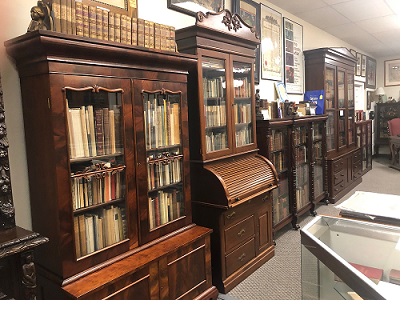 and warehouse space—there’s much more there than one might expect. In addition to a very large stock of antiquarian and rare books, they offer prints, posters, artwork, collectible magazines, comics, postcards, vinyl recordings, and memorabilia.
Ron Cozzi, the owner of Old Editions, started out in a second floor location he called the Buffalo Book Studio in late 1974. Within days of the opening a natural disaster in the form of a serious blizzard blanketed the area, the National Guard and Army Reserves were called in to rescue life, limb and property, and Ron was shut out of his newly-opened shop for 3 months. An unusual beginning for any business. They can be reached at (716) 842-1734 and a selection of recent acquistions or other noteworthy or outstanding items can be found on their e-Bay page.
Philadelphia Rare Books & Manuscripts
PRB&M (Phildadelphia Rare Books & Manuscripts) is now entirely devoted to IRS qualified and other appraisals, collection building consultation, and to limited, private bookselling by direct offer only. Founded as a strictly antiquarian rare bookselling concern in 1984, PRB&M joined the Antiquarian Booksellers Association in 1985, executed its first major appraisals in 1991, established its website in 1997, created its range-expanding "Sessabks" in 2001, and welcomed visitors by appointment at The Arsenal between 2006 and 2021.
Since 1 January 2022, that long experience has been brought to bear in service of their clients' needs in newly focused & still evolving ways. For more information please call (215) 744-6734 or visit their website.
Exceptional Books from Back of Beyond (Moab, Utah)
An Account of the Voyages Undertaken by the Order of His Present Majesty for Making Discoveries in the Southern Hemisphere... 1773, 1777, 1785. Ten volumes, (nine quarto volumes plus one folio atlas volume) all bound uniformly in contemporary tree calf with elaborately gilt-decorated spines with raised bands and red and green morocco spine labels interspersed with gilt stamped image of Cook's ship the Endeavour or Resolution. Volumes have been expertly re-backed... (continue reading)
A Selection from D & D Galleries
A smorgasbord or garden of bibliophilic delights described and offered for sale by D & D Galleries in Hillsborough, NJ, specialists in British and American literature... (read more)
Gibson's Books in Owens Cross Roads in northern Alabama offers a general stock of books and periodicals in a variety of subjects, especially books (and) magazines about books. They have an extensive stock of back issues of Book Source Monthly and Book Source Magazine, from the period before May/June 2013, when we discontinued printing this magazine in hard copy. (see more)
Freeman’s September 21 Auction
Freeman’s September 21 Books and Manuscripts auction inaugurated Freeman’s fall season with the remarkable $277,200 sale of New Englands First Fruits. The extremely rare first edition includes the first printed account of 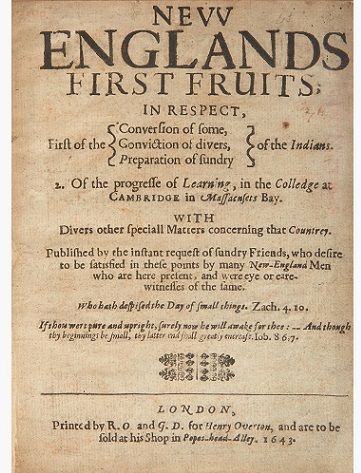 Harvard University—and garnered considerable interest in the September 21 auction, with competitive bidding driving the sale price more than nine times above its pre-sale high estimate of $30,000.
“We’re thrilled by the successful sale of New Englands First Fruits, and so is the consignor,” says Darren Winston, Head of Freeman’s Books and Manuscripts department. “This is the first copy to be offered at auction in over 20 years, and today’s result confirms the market demand for this material, setting a new world auction record for the title.”
In addition to New Englands First Fruits, a rare and beautiful first edition of L. Frank Baum’s classic The Wonderful Wizard of Oz—made famous by the 1939 classic film starring Judy Garland—achieved $37,800, more than tripling its pre-sale high estimate of $8,000-12,000.
“Several important Americana manuscripts and documents likewise commanded competitive bidding wars, resulting in sale prices that far exceeded estimates—including the Narrative of Sojourner Truth, a scarce copy that achieved $27,720 against the estimate of $1,500-2,500. A 1738 colonial treatise on paper money sold for $21,420 (estimate: $1,000-1,500), and a very rare 1683 document issued to the very first purchaser of Pennsylvania land sold for $20,160 (estimate: $5,000-8,000).
“We’re now turning our attention to our November 15 Books and Manuscripts: Rare Americana auction,” said Darren Winston, “which builds on the department’s recent successes in bringing rare, foundational items to market, including the $4.42 million sale of a …more
by John C. HuckansCivil War Isn’t Funny
(originally published October 11, 2017)
Same goes for any war. When Gilbert a'Beckett was writing his comic histories (England, Rome, etc.) one has to wonder what was going through his mind. In a comic history of anything, most writers and readers understand it involves a lot of selective historical amnesia, mood-altering tricks and other forms of cover-up. But passage of time softens a lot of things – we remember getting mail from Hastings (Sussex) years ago, with part of the postmark reading “Hastings – popular with tourists since 1066”. Although I could imagine a'Beckett writing that, I doubt if he would have wanted to handle the circumstances surrounding the death of Edward II (father of the great Edward III) whose general ineptitude and poor judgment, unduly influenced by his preoccupation and infatuation with Hugh Despenser (the younger), ultimately led to his execution. In those days …more
by John C. HuckansRace to the Bottom (or plumbing the depths)
(Review of "Licensed to Lie: Exposing Corruption in the Department of Justice")
[Ed. Note - This review was first published here in Book Source Magazine several years ago. In light of recent events, I think we can agree that plus ça change, plus c'est la même chose.]
According to the experience of most booksellers I know, Amazon and the internet have nearly trashed the antiquarian book trade – and in order to survive many independent booksellers have become data-entry catalogers for the online giants. I think it was at least twelve years ago when I first heard someone's opinion that antiquarian book-selling had become a rat race to the bottom.
And then there's the crazy pricing. Many of us have seen identical copies of the same title offered on-line for anywhere from 99¢ to $100,000, so when recently published books, especially good ones, become remaindered for whatever reason there are often incredible bargains to be had.
Once in a fit of temporary madness I bought a case or two of Geoffrey Wawro's Quicksand: America's Pursuit of Power in the Middle East (New York, Penguin, 2010) on the internet (Biblio). Written by a professor of military history at the University of North Texas and published at $37.95, the three or four dollars a copy I paid was actually cheaper than the paperback version, and missionary-like I offered to sell them at cost to anyone interested in the the Middle East. I had already read the book and naïvely thought others would jump at the chance – I thought wrong and except for the two copies I sold and three others given away to friends, I still have most of the shipment.
In 2014 another controversial book was published that explored corruption and obstruction of justice within the Department of Justice. The title, appropriately enough, is Licensed to Lie: Exposing Corruption in the Department of Justice (Dallas, Brown Publishing Group, 2014), by Sidney Powell. According to her bio “Sidney Powell served in the Department of Justice for ten years” and for twenty years has been a federal appeals attorney. Also, “She was the youngest Assistant United States Attorney in the country and the youngest elected fellow of the American Academy of Appellate Lawyers, for which she also served as President”.
Much of the book explores in excruciating detail the Federal prosecutions that grew out of the Enron collapse in the early years of the new century (and) the 2008 prosecution, conviction, and ultimate acquittal and exoneration of Senator Ted Stevens of Alaska. (The Stevens case came at a politically convenient time that changed the balance of power in the Senate). In all high profile prosecutions, the cost of providing an adequate defense places an immense economic burden on the accused, and in a Gogolesque scenario, when threatened with financial ruin many defendants have struck immunity deals and have become witnesses for the prosecution, telling the court what they've been instructed to say, even if they absolutely know it to be untrue or misleading. …more
The antiquarian book fair that never closes. Any sponsoring friend of Book Source Magazine is eligible for free participation ("booth" or "stand") in our virtual book fair
***
Austin's Books (Wilmington, VT ). American History, Teddy Roosevelt, Fly Fishing, Travel, Maps, Prints & Ephemera. Tel: (802) 464-8438. (Browse Inventory)
Back of Beyond Books (God’s Navel, Utah). Specializing in Western Americana and the human and natural history of the Colorado Plateau since 1990. Always discovering new rare finds. (Rare and Collectible Inventory)
D & D Galleries (P.O. Box 8413, Somerville, NJ). Founded in 1985, with specialties in British and American literature. Eclectic inventory (mostly English language) ranges from the 15th through the 20th centuries with sub-specialties in Fine Bindings, S.T.C. and Wing books, Lewis Carroll (C. L. Dodgson), Charles Dickens, presentation and association material as well as 17th and 18th century British history. Members of the Antiquarian Booksellers Association of America, the International League of Antiquarian Booksellers, and the Provincial Bookfair Association of Great Britain. Tel: (908) 904-1314. (Featured Selections)
Early Aeronautica (Midland, MI). Vintage books, documents & ephemera relating to early aviation. Tel: (989) 835-3908; (520) 373-2622 (Newest Arrivals)
Gibson's Books (3137 Old Highway 431, Owens Cross Roads, AL). Large stock, specializing in local and southern history, including Civil War, Southern fiction, cookery & ephemera. Also, back issues of Book Source Monthly/Book Source Magazine from 1985-2013. Tel: (256) 316-0054. (Newest Arrivals)
Old Editions (954 Oliver St., North Tonawanda, NY). Rare & Antiquarian Books, Paper & Ephemera/Prints, Posters & Original Art Works. One of the largest antiquarian bookstores in New York State. Tel: (716) 842-1734. (Featured Selections)
Quill & Brush (Middletown, MD). Specialists in first edition literature, mysteries, poetry & collectible books in all fields. Authors of well-known books on book collecting & compilers of over 200 individual Author Price Guides. Visit us on the web, or in person by appointment. Tel: (301) 874-3200. (Newest Arrivals)
R & A Petrilla, Booksellers. (P.O. Box 306, Roosevelt, NJ). Established 1970. Online since 1995. Trading in unusual books, documents, and manuscripts in various fields of interest, including farm life. (New Arrivals)
W.H. Adams, Antiquarian Books (Hobart, NY). General antiquarian with emphasis on England and early classics. Located in the Book Village of Hobart in the Catskills. Tel: (607) 538-9080. (Newest Arrivals or...)
Hermann Collection Achieves Nearly $1 Million at Hindman
On June 21 and 22, Hindman Auctions’ American Historical Ephemera & Photography sale realized $989,781. The Civil War and American Militaria Collection of Bruce B. Hermann was the focal point of the auction, with bidders eagerly competing. Rare military uniforms were among standout lots offered on the second day of the sale, while outstanding Civil War era and 19th century photographs highlighted the first day of the auction.
On June 22, Hindman presented the Civil War and American Militaria portion of the collection, which achieved an impressive sell-through rate of 96 percent. Hermann has an extensive background in American and Western European military history, with more than 30 years of experience collecting and dealing in 16th to 20th century militaria. Hermann also served as an appraiser on the PBS series The Antiques Roadshow for 11 seasons.
Standout lots included a Uniform of the "Cladek Zouaves," identified to Private Alfred T. Brophy, Co. K, 35th New Jersey Infantry (lot 370) which exceeded its estimate of $9,000-12,000 to sell for $20,000. The uniform highlighted a notable selection of lots related to the Zouave regiments.
A collection of items attributed to Thomas W. Johnson, Co. K, 4th Delaware Infantry, including a frock coat, cap, belt rig, and cartridge box was another noteworthy lot, achieving $10,635. An archive identified to Brigadier General Lansing B. Swan, including a New York militia frock coat, belt, epaulettes, and daguerreotype exceeded its estimate, selling for $8,125 against a presale estimate of $4,000-6,000.
Military headgear was also among top performers from the Hermann Collection, including a 4th Rhode Island Infantry kepi identified to Captain Martin Page Buffum, POW at Petersburg which realized $7,500 and a Model 1832 U.S. Infantry Shako for enlisted soldier, which sold for $6,875.
Emerging as the top lot of the first day of the auction was the Rosborough family archive, which sold for $37,500 against a presale estimate of $15,000-25,000. The archive included letters relating to the California Gold Rush, the Modoc War, the Klondike Gold Rush, and early settlement and mining operations in Idaho Territory, Utah Territory, Nevada, and …more
by John HuckansDreadnought & Saying Goodbye
[Ed. Note - The following is a book review and announcement of the last issue of Book Source Magazine that would appear in “print-on-paper” format (May/June, 2013). Parts of the magazine were ultimately sold off to another publication and we continue to publish on-line to the present day. A small stock of back issues were taken to the Cooperstown Antiquarian Book Fair the weekend of June 25th where they were available free of charge.]
*
I've been reading Robert Massie's Dreadnought: Britain, Germany, and the Coming of the Great War (New York: Random House, 1991) for much of the winter – it's not because I'm a slow reader, but Massie's ability to breathe so much life into the history he knows so intimately makes the reader want to take plenty of time to absorb and reflect on what's been read. I wouldn't rush through one of Massie's books any more than I'd down a glass of the best oloroso or cortado Spanish sherry as if it were a pint of draft Yuengling. Nothing against Yuengling – it's probably my favorite non-pretentious go-to lager.
The parallel narratives, from both the English and German perspectives, relying heavily on letters, journals, contemporary accounts and earlier histories, focus on the late Victorian and Edwardian periods when ship design and construction methods were changing radically, naval tactics were undergoing a major rethinking, and all of it happening in …more
by John HuckansReflections on the 2020 Election (Part 5)
The unfortunate legacy of the 2020 election and the way it was carrried out is the partisan divide that remains as bitter and uncompromising as I've ever seen it, even though a lot of folks declare themselves positioned somewhere between the angry rhetoric of the far right and the sanctimonious ignorance of the far left.
Many on the left seem to find it easier to participate in the empty ritual of “virtue" signalling, rather than spend time and effort sifting through information from a variety of sources, think deeply about matters of sound public policy, and then decide for themselves what is truly virtuous. And many on the right tend to share inflammatory memes that are tiresome and tedious, even when sometimes true. Add to this the continual stoking of group identity discontent and you have the dangerous stuff of which civil wars are made.
[Personal note: I have it on pretty good authority that civil war can be a rather nasty way to sort out political differences, except perhaps, for the policy-makers and planners who promote and profit from the exercise while making sure people other than themselves are the ones trying to survive on the battlefield. According to letters from one of my great grandfathers who in 1862 was a member of the 44th regiment (company B) of New York's Volunteer Infantry, the battle at Antietam on September 17, 1862, was not a pleasant day's outing. Older family members recalled he didn't talk about it much in later years.]
The nation's old melting pot theory, formalized in Latin as “e pluribus unum” by Adams, Jefferson et al. and expanded on based on the early observations of Crèvecoeur, Tocqueville and others, is now not only no longer fashionable, but often disparaged by political opportunists who discovered they can profit politically by dividing people according to ethnicity, race or national origin, often inventing and exaggerating distinctions where none had consciously existed before. Carried to the extreme, it has become formalized as group identity politics or critical race theory (a subset of critical theory) and is reflected in all areas and levels of government, school curricula, media, entertainment and public planning. It has been routinely exploited as a means to reinforce government control over peoples' lives.
About thirty years ago eminent mid-century American historian Arthur M. Schlesinger Jr. had a lot to say on the subject in his The Disuniting of America: Reflections on a Multicultural Society. In it he begins with …more
Sales Results of PBA's April 21st Sale
On April 21st, 2022, PBA Galleries offered a small but highly important group of rare maps, views, and pictorial letter sheets relating to the early history and later development of the city of San Francisco. 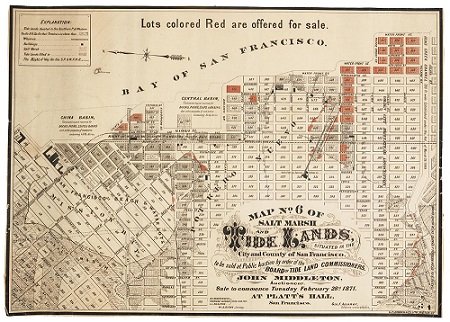 The important assemblage of graphic and cartographic material from the Charles Fracchia Collection, numbering just over 130 lots, was gathered over half a century by one of the leading historians of the city. The exceptional results often greatly exceeded the published presale estimates, but many of the items were of such rarity, even unique, that the estimates mostly served as starting points. In the end, all 134 lots sold, a “white glove” auction, the first in the 30-year history of the Galleries.
Charles Fracchia, who passed away in the summer of 2021, was the founder of the San Francisco Historical Society, and one of San Francisco’s most respected historians. He led historical walking tours for two generations of San Franciscans; taught history courses at the University of San Francisco, San Francisco State, and City College; and lectured at venues throughout the city. He was the author of numerous books, and was publisher of the historical journal The Argonaut and quarterly newsletter Panorama. He was an active member of various clubs such as the Book Club of California, and the Association Nationale de Bibliophilie, and was one of the founders of Rolling Stone magazine.
The bidders were passionate about the Fracchia collection, and in particular lithographs and views of San Francisco. One example of this is Vue de San Francisco en 1860, a tinted lithograph looking toward Yerba Buena Island, that sold for $10,625, twice the high estimate. In the same category, a George Baker lithograph of San Francisco went to a fortunate bidder for $11,785. 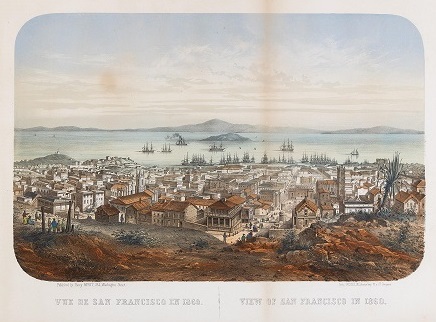 The collection featured numerous maps of the entire city,from its infancy to the years of rebuilding after the devastating earthquake. But perhaps of even greater interest were the local maps featuring the neighborhoods being divided up into lots, for sale to homesteaders and speculators. One in this category that went well above the estimate was a map of tide lands for sale, printed by G.T. Brown, the first African-American lithographer in California, which sold for $10,000. Another map that attracted the interest of bidders was Official Map of Chinatown in San Francisco, a color lithograph from 1885. The lot sold for $15,000, ten times the high estimate.
The large selection of pictorial letter sheets, graphic portrayals of San Francisco in the wild days of the Gold Rush, captured its amazing growth from outpost to metropolis in a few short years. These brought high prices across the board – among the most notable was a letter sheet with a large double-page lithographed Bird’s Eye View of San Francisco … July 1852, published by Cooke & LeCount, which sold for $9,375. The auction foreshadows what is to come at PBA. The second portion of the Charles Fracchia collection, featuring an important group of lithographed views of San Francisco, with related material, will be offered in the fall of 2022.
PBA Galleries holds sales of fine, rare and collectible books every two weeks. They are currently accepting consignments for Fine Literature with Beats & the Counterculture. For more information regarding upcoming sales, consignments, or auction results, please contact PBA Galleries at (415) 989-2665 or pba@pbagalleries.com.
